
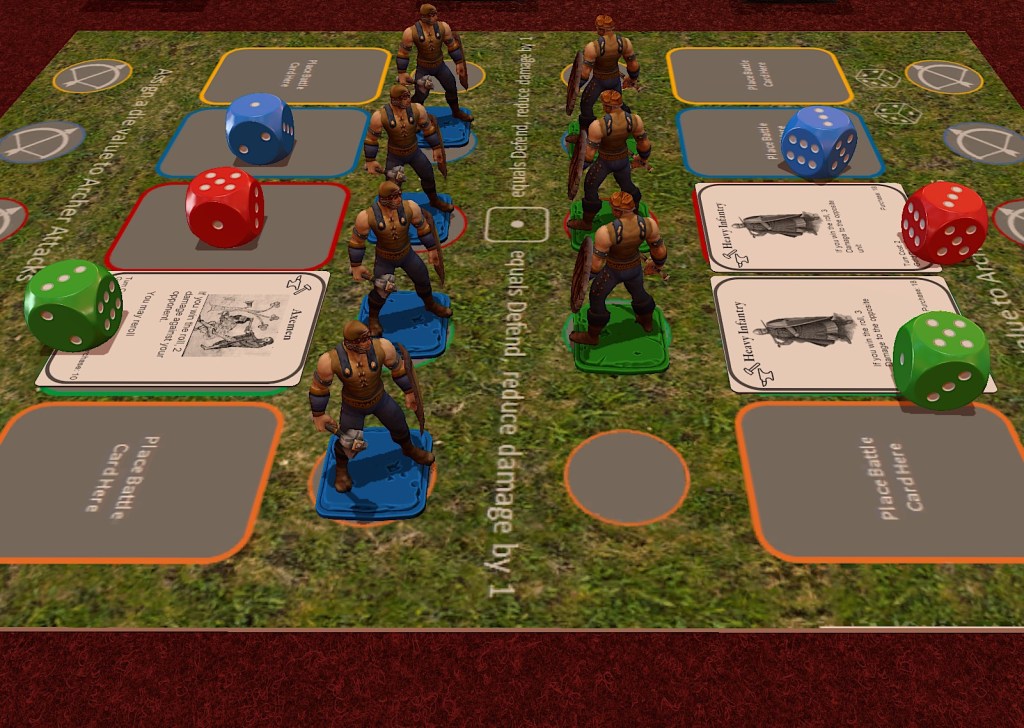
When I originally planned Order in Chaos battles, I wanted the entire line of troops to attack simultaneously but with different outcomes. Flipping over individual cards and watching each one play out was tedious. So the second iteration of Order in Chaos featured colored die. Players would compare the blue dice, red dice, etc. One could simply roll 5 die and determine the outcome of five different skirmishes.
However, even though armor and troop types made battles multi-dimensional, it still felt flat. The entire strategy of the game came down to lucky rolls, even if Players did make the die values work to their advantage with various technology.
I first read about the abolishment of die in a blog that Isaac Childres wrote. His theory was that if you had all the best advantages in a game, you should win and not be handicapped by an unlucky roll. I saw his perspective in how battles came out in Order in Chaos.
The third iteration featured an Attack deck. Players start with cards 1 through 6 (just like a die) two times. There is a common Attack deck featuring the same thing but four times on the table. Over the course of the game, Players could edit their deck by removing and adding cards. They could purposefully do this via Build projects or Chance cards could force them to. Overall, it meant that when you ended up at the final battles, you had more control over the outcome and less chance.
What do you think? Do you appreciate the drama of bouncing die or the more curated strategy of deck building?
 Weak Knight Games
Leave a comment